When growth outpaces structure
Growth can hide structural strain inside a consultancy. This case study shows how the Burnout–Flourish Check-In helped a consultant step back, stabilise first, and choose the right strategy for his business, life and vitality.

.jpg)
A stabilising moment for a delivery-driven consultant
Growth without structure often creates invisible strain inside a consultancy.
Many consultants spend their careers helping clients manage risk.
They identify exposure early, prevent costly mistakes, and ensure the right structures are in place before pressure builds.
But far fewer apply that same discipline to the way their own consultancy operates.
Sean Bradley’s experience illustrates this clearly.
Sean is the founder of Sean Bradley Consultancy, advising contractors in the construction and engineering sector on contract strategy, commercial risk, time and cost claims, and dispute resolution. It’s high-responsibility work where precision, documentation, and sound judgement are essential.
.jpg)
His reputation was strong.
Demand for his expertise was steadily growing.
On the surface, it looked like a clear growth season.
But before deciding how to expand further, Sean completed the Burnout–Flourish Check-In – a short diagnostic designed to assess operating strain across three domains: life, business and vitality.
What the data revealed shifted the direction of his next season.
In this case study you’ll see
- What Sean’s Check-In revealed
- Why stabilising was the right move before growth
- How gaps in business rhythm were creating pressure
- The practical changes he made
- What other consultants can learn from it
Not burnout. Not failure. A structural signal.
Sean wasn’t struggling.
He wasn’t burned out.
And his consultancy wasn’t failing.
In fact, two of the three domains measured by the Check-In were strong.
Life: 19 / 25
Business: 10 / 25
Vitality: 16 / 25
Zone: Stabilising
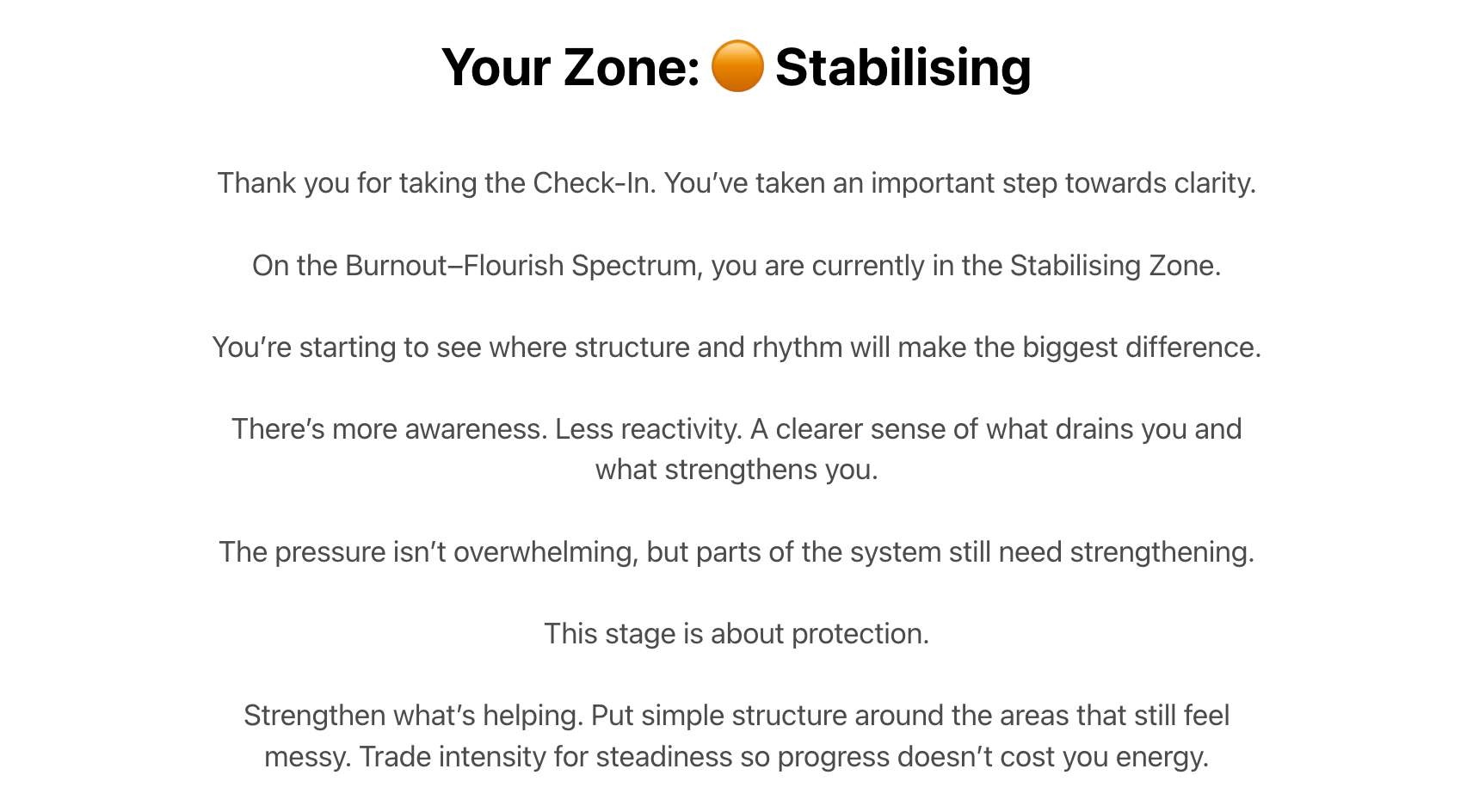
On instinct, Sean believed he was entering a growth season but the data suggested stabilisation first.
Sean’s life foundations were healthy.
He had a morning rhythm, time for his family, and space outside work.
His vitality was steady.
Sleep, nutrition, and physical resilience were supporting the demands of his role.
But the business structure supporting his delivery rhythm was under strain.
That distinction matters.
This was not a crisis story.
It was an infrastructure story.
The invisible risk in growth seasons
Like many independent consultants, Sean had a strong appetite for growth.
Momentum was building.
Opportunities were appearing.
It would have been easy to interpret this as a signal to push harder.
But the Check-In revealed an underlying risk.
Growth was beginning to outpace the structure of the business.
Delivery demands were increasing.
Client questions were multiplying.
The working day was beginning to stretch further into the evenings.
Marketing activity was happening reactively rather than consistently.
None of this meant the business was failing.
But it did mean the foundations supporting growth were weakening.
Left unchecked, that imbalance would eventually begin to erode the life and vitality foundations that were currently strong.
It also carried another form of exposure.
When consultants become stretched, response times slip, communication slows, and client experience begins to suffer.
For someone whose reputation depends on precision and reliability, that kind of drift creates professional risk.
The stabilising lens
Stabilising is often misunderstood.
It doesn't mean slowing down.
It means strengthening the structure that allows growth to continue safely.
For consultants operating in the Stabilising Zone, the goal isn't recovery.
It's protection.
Protection of energy.
Protection of delivery quality.
Protection of client experience.
Protection of the life the business is meant to support.
This perspective reframed Sean’s next season.
Instead of accelerating growth immediately, the focus shifted to strengthening the business rhythm across his consultancy.
Seeing the rhythm
Using the Business Rhythm Six framework, we examined how Sean’s consultancy was operating across six core modes:
- Create
- Promote
- Sell
- Deliver
- Support
- Collect
Like many delivery-driven consultants, Sean’s time and energy were concentrated heavily in delivery.
Other modes were under-structured.
Promotion was reactive.
Client support relied heavily on Sean personally responding to messages and emails.
Answers to common client questions were repeated rather than captured.
The result was hidden strain.
Each interruption – a quick email, a clarification, a repeated explanation – seemed small.
But together they fragmented focus and extended the working day.
At the same time, the client experience was becoming more dependent on Sean’s personal availability.
For a consultant working in high-responsibility environments, that kind of dependency carries risk.
The structural shift
This is where the FAQ Engine became relevant.
Not as a marketing tactic.
As infrastructure.
The FAQ Engine is a simple weekly rhythm built around answering real client questions and capturing that knowledge in a structured hub.
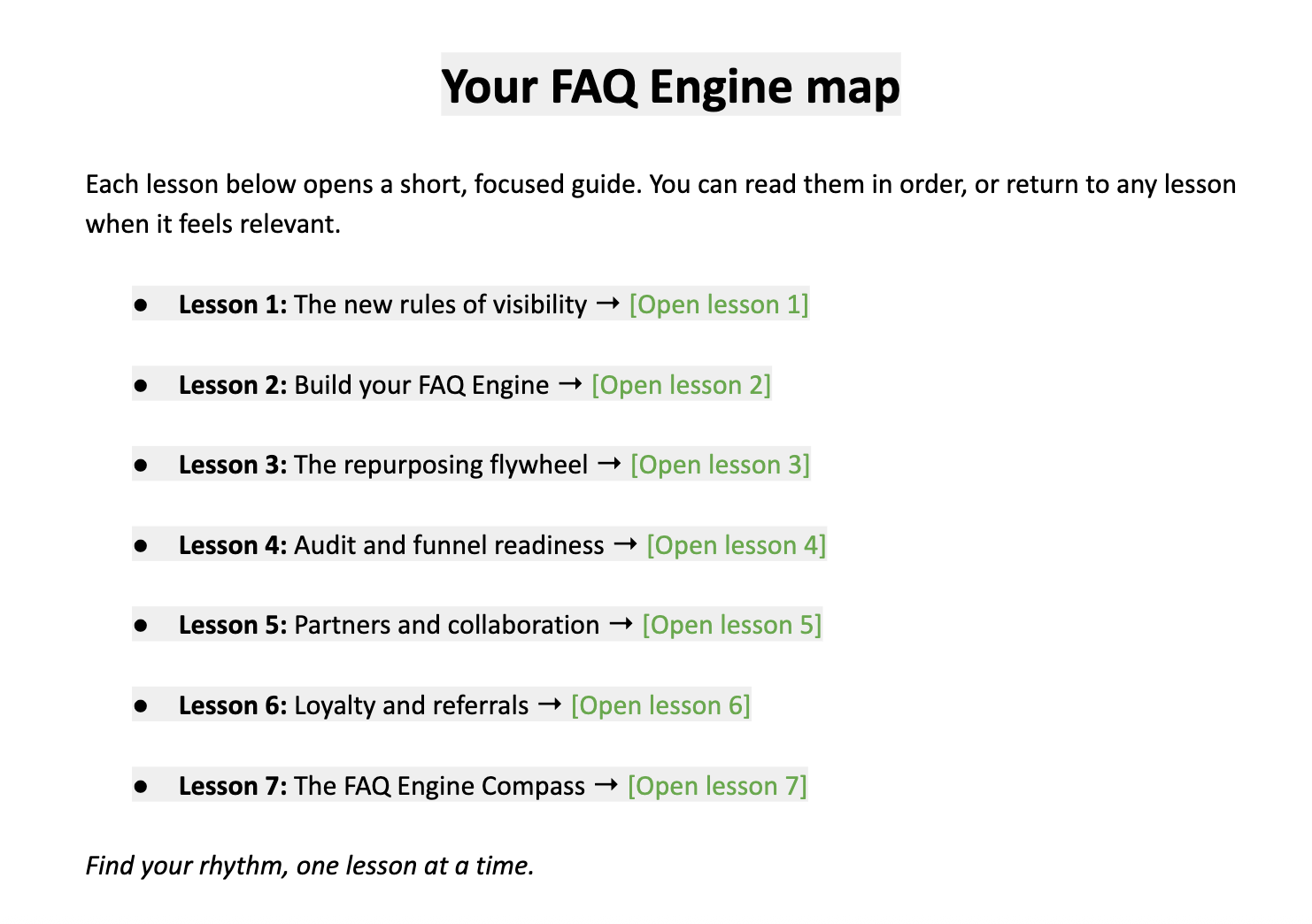
Each answer becomes:
- a visible insight for future clients
- a support resource for existing ones
- a clear answer he can reference whenever the same question appears
- a building block for consistent visibility
That single shift began stabilising several parts of Sean’s business rhythm at once.
Promotion became easier because he no longer had to invent content themes or decide what to write about. Each FAQ answered a question his clients were already asking – questions he knew inside out.
Those answers could then be repurposed into a LinkedIn post, a blog article, and a weekly Ask Sean email to his list, creating calm, consistent visibility.
Client support became more proactive.
Common questions were captured inside a growing FAQ hub, allowing clients to access clear answers without always waiting for a reply.
New clients could be guided through structured onboarding resources within that hub, clarifying expectations and reducing uncertainty from the start.
Existing clients also gained a form of self-service access to insights and explanations they often needed quickly.
And Sean regained time that had previously been lost repeating the same explanations across emails and messages.
What looked like a content system was actually something deeper.
A rhythm stabiliser.
Through one structured approach, Sean was strengthening several modes of the Business Rhythm Six simultaneously:
- Promote — consistent visibility through weekly FAQs
- Deliver — clearer onboarding and expectations
- Support — structured answers instead of repeated explanations
- Collect — feedback, insights, testimonials and referrals
All of this created a healthier rhythm across the business while actually reducing the amount of effort required to maintain it.
Early impact
The biggest change wasn't technical.
It was strategic.
Before completing the Check-In, Sean assumed the next season of his consultancy should focus on growth.
The data suggested something different.
Instead of pushing expansion immediately, he chose to stabilise the structure underneath the business first.
That meant strengthening the systems supporting promotion, delivery and client support before increasing demand further.
This shift removed a developing risk.
Without intervention, the likely trajectory was predictable: increasing delivery pressure, longer evenings, reactive marketing, and gradual strain on the life and vitality foundations that were currently strong.
By stabilising first, Sean protected the next phase of growth rather than forcing it prematurely.
One response from the Check-In was particularly revealing.
When asked which season best described his current position in life and business, Sean selected “Growing — I’m building momentum and expanding.”
That instinct made sense. Demand for his expertise was increasing and the business appeared to be moving forward.
But the diagnostic scores told a different story.
While life and vitality were strong, the business structure underneath his delivery rhythm needed strengthening before further expansion.
Sean’s reflection
“On paper it looked like a growth season for me.
Mentally and physically I felt ready to push forward.
The Check-In showed I was actually operating in the Stabilising Zone, with structural gaps in delivery and promotion.
Paul’s audio interpretation and resources helped me prioritise what to strengthen first and fix the gaps without adding more hours.”
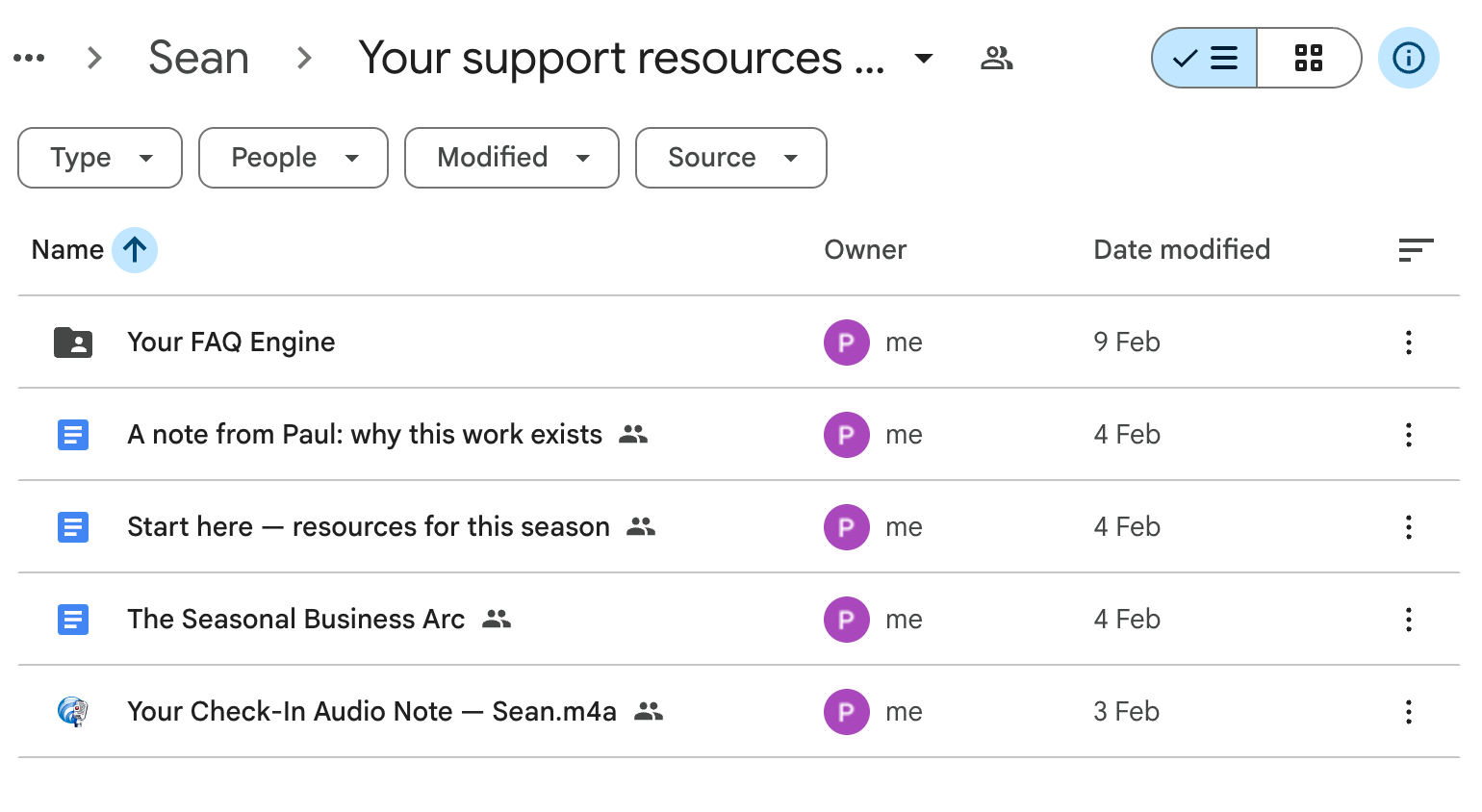
Since completing the Check-In, Sean now treats his operating position as an important signal before planning any new season of growth.
Rather than assuming the business is ready to expand, he first checks where he is operating across life, business and vitality and strengthens any weak areas before pushing further.
The Check-In has effectively become a personal dashboard for managing the health of his consultancy.
A lesson for independent consultants
Many consultants assume the next step in their business is more growth.
Often the real need is something else.
Better rhythm.
Stronger structure.
Clearer awareness of where they are actually operating.
Sean spends his career helping clients identify and manage risk.
The Burnout–Flourish Check-In helped him identify a developing risk in his own consultancy before it created real pressure.
The most important decision he made was not choosing a growth strategy.
It was pausing long enough to diagnose where he was actually operating from.
If you want to see clearly where you are operating across life, business and vitality, the place to start is the Burnout–Flourish Check-In.
It takes about five minutes to complete.
Every response is personally reviewed by me.
You receive your zone, your domain scores, and a short audio interpretation explaining what your results reveal and what to strengthen next.
You’ll also receive a personalised resource folder tailored to your situation, similar to the one Sean received above.
It’s private, not automated, and designed to help you plan your next season with clarity.
With thanks to Sean for allowing his Check-In data and experience to be shared as part of this case study. If you’d like to follow Sean’s insights, you can connect with him on LinkedIn here.
Con cura e chiarezza,
Paul
Your Flourishing Coach